Heavy-Duty Warehouse & Collapsible Pallet Racking Systems
Configured for heavy unit loads, high-density handling, seasonal flex-storage, and integrated automated distribution hubs across international operating environments.
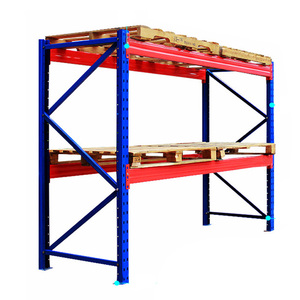
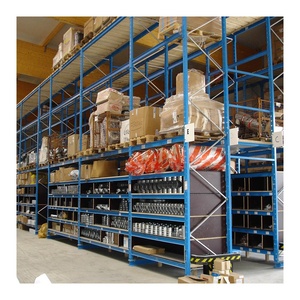
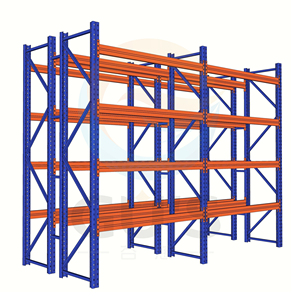
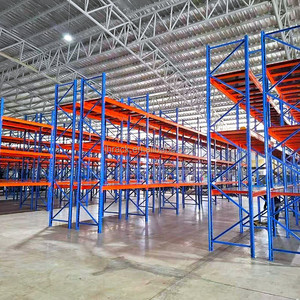
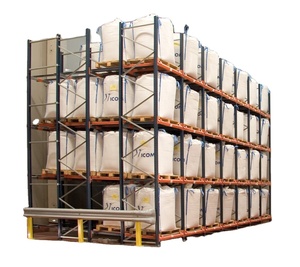
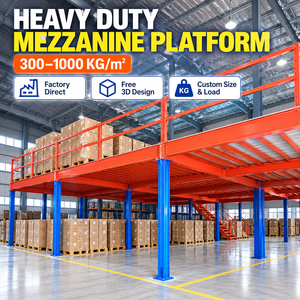
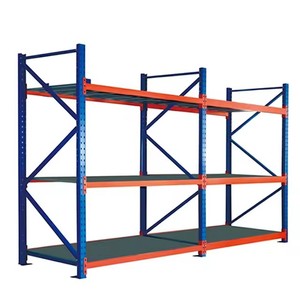
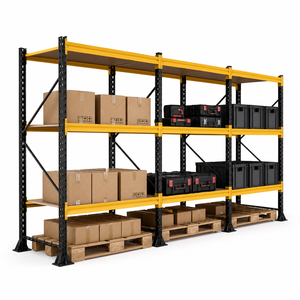
CE Certification, EN 15512 Compliance & Collapsible Load Dynamics
Evaluating structural deformation tolerances, moment-resisting connections, and dynamic payload distribution for heavy-duty collapsible racking in automated and global logistics hubs.
EN 15512:2020 Structural Limit State Calculations
Unlike standard static shelving, CE-certified heavy-duty collapsible pallet systems require finite element modeling (FEM) based on second-order global frame analysis. Upright frames are calculated considering lateral torsional buckling, shear deformation, and torsional-flexural buckling of thin-walled cold-formed steel sections (Q355B and S355MC grades). Beam-to-column connector moment rotation curves ($M$-$\phi$) are verified in physical destructive test rigs to guarantee real-world safety factors ($\gamma_M \ge 1.4$) under dynamic fork-truck impact and unbalanced pallet loadings.
Kinematics of Collapsible Pin-Hinge Geometry
The engineering breakthrough of heavy-duty collapsible post systems rests on interlocking geometric shear lugs combined with high-tensile retaining pins. When erected, the base frame transfers load directly down the vertical axis of the hollow structural section (HSS), avoiding eccentric bending moments. When disengaged, the corner posts fold flush within the inner perimeter of the perimeter channel base. This yields a 4:1 to 5:1 volume reduction ratio, slashing reverse-logistics freight expenditures and warehouse dead-space allocation during seasonal turnover.
Seismic Dissipation & Dynamic Base Isolation
For operations located in seismic zones (conforming to EN 1998-1 Eurocode 8 and RMI MH16.1), collapsible pallet racks incorporate flared column feet with precision laser-slotted anchor patterns. This engineered flexibility dampens low-frequency ground acceleration waves through controlled micro-slip displacement. By redistributing seismic shear loads across the continuous perimeter base rather than concentrating stress into a solitary concrete expansion anchor, floor cracking and sudden anchor pullout failures are effectively engineered out of the structure.
| Performance Parameter | CE Certified Collapsible Stacking Racks | Conventional Fixed Selective Racks | Drive-In / Deep Stacking Systems |
|---|---|---|---|
| Load Capacity Per Bay / Tier | 1,000 kg – 3,000 kg (Stackable 4–6 high) | 1,500 kg – 4,500 kg per beam level | 1,000 kg – 1,500 kg per pallet runner |
| Storage Density Efficiency | Dynamic: High footprint flexibility | Medium (Requires dedicated 3.2m aisles) | Ultra-High (LIFO bulk storage matrix) |
| Empty Return Freight Efficiency | Up to 75% cube reduction (Fold-Flat) | 0% (Fixed structure cannot be collapsed) | 0% (Bolted fixed frame architecture) |
| Civil Foundation / Anchor Demands | Zero floor anchoring (Self-supporting) | Chemical/Mechanical floor anchors required | Extensive anchor grid & floor guidance rails |
| Reconfiguration Speed / Agility | Under 60 seconds per module by hand/fork | Requires multi-day teardown and unbolting | Rigid layout; weeks of civil re-engineering |
| European Standard Verification | EN 15512, EN 10204 3.1, CE Machine Dir. | EN 15512, EN 15620, EN 15635 | EN 15512, FEM 10.2.07 |
Technical Insight on Load Safety Factor: Under the European Standard EN 15512:2020, structural calculations for cold-formed steel racking cannot rely on elastic bending theory alone. Yield strengths must account for cold-work hardening across the corner profiles of the uprights. Our CE-certified collapsible systems integrate finite element strain gauge data verifying that full-load stress nowhere exceeds $0.85 f_y$, mitigating structural fatigue failure even under round-the-clock 3-shift intermodal cycles.
Strategic Sourcing & Procurement Trends (2025–2030 Horizon)
How Fortune 500 3PLs, cross-border retail conglomerates, and cold-chain operators are re-evaluating capital equipment procurement around agility, automated compatibility, and Scope 3 emissions.
1. Capex Shift: "Dynamic Fleets" Over Fixed Steel Assets
Traditional multi-million-dollar fixed rack installations commit enterprise operators to static warehouse footprints for 15+ years. As lease horizons contract to 3–5 year agreements in gateway logistics parks (Rotterdam, Antwerp, Hamburg, Long Beach), global supply chain directors are redirecting capital expenditure toward modular, collapsible asset pools. These racks travel with the business, scale linearly during Q4 peak surges, and can be redeployed across facilities without permanent floor damage or lease remediation costs.
2. Scope 3 Emissions & Reverse-Logistics Optimization
Under corporate sustainability directives (such as the EU Corporate Sustainability Due Diligence Directive), transport carbon emissions are subject to stringent audits. Empty rigid steel cages or shipping racks transport 80% dead air on backhaul runs. Purchasing departments now benchmark collapsible racks based on their "Return Log Ratio." By condensing 120 collapsed units into a single 40ft High Cube container—versus only 30 rigid units—enterprises slash backhaul freight carbon intensities by 72% per pallet position.
3. AMR / AGV Vision Target Interoperability
Collapsible racks are no longer strictly manual handling assets. Next-generation procurement specifications mandate integrated corner-post optical reflectors, floor fiducial cutouts, and bottom-clearance dimensional tolerances of $\pm 1.5$ mm to accommodate Autonomous Mobile Robots (AMRs) and Automated Guided Forklifts (AGVs). Modern collapsible systems feature CNC-machined interlocking base locating pins that provide automated robotics with the absolute positional repeatability required for high-speed dark warehouse stacking.
Material Innovations: High-Yield Alloys & Self-Healing Coatings
The transition from baseline structural mild steel to micro-alloyed ultra-high-strength steel sheet and eco-friendly galvanic surface treatments.
Micro-Alloyed High-Yield Steels (Q355B to S420MC)
Modern collapsible racks face extreme impact loads at the post entry points. Leading exporters have replaced standard low-carbon Q235B cold-formed tubes with micro-alloyed niobium-titanium steels (such as S355MC and S420MC). These metallurgical advancements increase yield strength ($f_y$) by over 40% while preserving room-temperature elongation ($\ge 20\%$). The result is an upright column capable of absorbing dynamic forklift impacts without sudden shearing or micro-cracking across heat-affected weld zones.
Zinc-Aluminum-Magnesium (ZAM) & Epoxy Duplex
For sub-zero cold chain storage (-30°C) and corrosive dockside cross-dock environments, standard powder coatings deteriorate through micro-porosity and under-film corrosion. Sourcing specifications are rapidly shifting to continuous hot-dip Zinc-Aluminum-Magnesium (ZAM) alloy coatings or automated e-coat primer with electrostatically applied thermo-hardened polyester finish. ZAM exhibits remarkable self-healing passivation at laser-cut edges and drilled holes, delivering up to 3,000 hours of neutral salt spray resistance (ISO 9227).
Robotic Laser-Tracking Weldment Quality
The structural integrity of collapsible stacking feet hinges on the cyclic fatigue strength of the base-to-cup weld seam. Top manufacturers employ 6-axis robotic welding cells equipped with real-time laser seam-tracking. This guarantees full penetration fillet welds with controlled heat input, eradicating porosity and spatter. Every batch undergoes ultrasonic or magnetic particle testing to verify compliance with EN ISO 5817 Quality Level B, ensuring uncompromised load-bearing integrity under full 6-tier vertical stack loads.
Why Global Supply Chain Leaders Partner With Us
Delivering end-to-end reliability: from turnkey civil structural design and EN 15512 calculation packages to automated lean production and global containerized shipping.
In-House Structural Engineering & PE Stamps
Our engineering bureau executes full 3D structural analysis, structural calculations, and CAD layout plans tailored to your exact warehouse column grid, pallet metrics, and seismic conditions. We furnish certified engineering documentation and calculation sheets compliant with EN 15512, RMI MH16.1, and AS 4084, empowering EPC contractors and logistics planners to secure municipal building consents smoothly across European, North American, and Australasian jurisdictions.
Full Raw Material Traceability (EN 10204 3.1)
Every shipment is underpinned by rigorous metallurgical testing. We procure prime structural coils directly from premier integrated steel mills, complete with EN 10204 3.1 Inspection Certificates specifying chemical heat analysis and mechanical tensile/yield figures. Components undergo strict inline optical gauge verification, ensuring nominal wall thickness tolerances never vary by more than $\pm 0.05$ mm—eliminating structural weak points across large multi-thousand-unit procurement lots.
Full Lifecycle Support & EN 15635 Inspection
Our commitment extends beyond port delivery. We support system integrators and multi-site operators with installation supervision, load testing, comprehensive load capacity signage, and regular EN 15635 racking safety inspection training. Furthermore, our modular component architecture ensures that replacement posts, hinge pins, and base rails remain backwards-compatible for decades, maximizing capital asset longevity and minimizing obsolescence risks.
Heavy-Duty Collapsible Pallet Racks: B2B Sourcing FAQ
Authoritative answers to critical structural engineering, quality assurance, compliance, and cross-border logistics inquiries from technical procurement officers.
What exact testing and structural documentation verifies CE conformity for collapsible pallet racks?
How is vertical deflection calculated, and what limits apply under European standard EN 15620?
Can collapsible pallet racks perform safely in sub-zero cold-storage (-30°C) facilities?
How does container stuffing and ocean freight packaging optimize logistics costs for overseas buyers?
What are the recommended inspection intervals under EN 15635 for high-throughput distribution hubs?
How do collapsible stacking racks eliminate the floor anchoring damage common in leased 3PL properties?
Consult with an Industrial Storage Structural Specialist
Accelerate your warehouse volumetric capacity, reduce return logistics freight costs, and ensure absolute CE / EN 15512 structural compliance. Contact our application engineering team today for layout designs, load calculations, and competitive FOB/CIF export quotations.