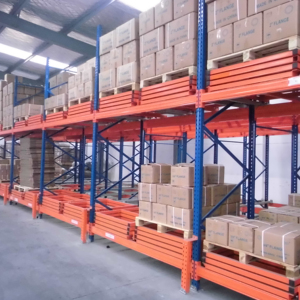
High Effective Heavy Duty Warehouse Storage Racking Push Back Pallet Rack
- Load Capacity:1,500 kg / Pallet
- Storage Method:LIFO Flow System
- Steel Profile:Q235B / Q355B Steel
Explore our precision-fabricated warehouse storage solutions designed for structural integrity, high payload capacity, seismic resilience, and seamless intralogistics throughput.
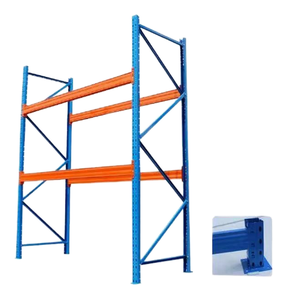
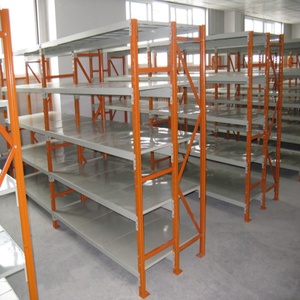
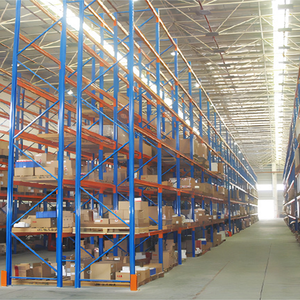
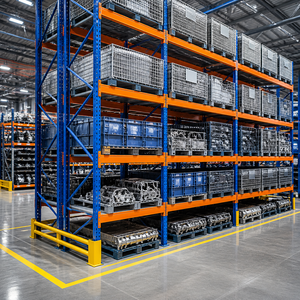
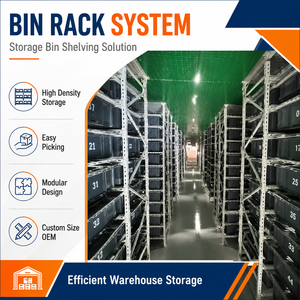
Modern intralogistics infrastructure has evolved beyond simple structural support matrices. In high-velocity bulk handling environments, a pallet racking installation is an active component of fulfillment logistics, directly impacting throughput efficiency, workforce occupational safety, and square-meter capital utilization. As a tier-one OEM/ODM bulk storage racking manufacturer, our design philosophy incorporates cold-formed thin-walled structural steel engineering, non-linear Finite Element Analysis (FEA), and strict compliance with international structural codes including European standard EN 15512:2020, American RMI ANSI MH16.1, and Australian AS4084.
Bulk storage warehouses present unique challenges: dynamic forklift impact vectors, non-uniform pallet deflection, high cyclic fatigue loading, and stringent seismic acceleration forces. To counteract torsional deflection under maximum rated load (working limits frequently exceeding 3,000 kg per beam level and 24,000 kg per bay), upright vertical members are profiled with multi-bend omega (Ω) geometries. This geometric stiffness significantly enhances the effective section modulus (Z-axis) while optimizing raw steel consumption, delivering exceptional strength-to-weight performance without structural redundancy.
Engineering Benchmark Insight: Cold-rolled structural profiles engineered from certified micro-alloyed steel (Q235B and high-yield Q355B / S355JR) feature continuous cold-roll forming without localized micro-fissures. Our automated continuous roll-forming lines feature up to 26 forming roll stations, guaranteeing dimensional accuracy down to ±0.5mm across 12-meter continuous upright profiles.
4-claw and 5-claw high-strength forged connection brackets configured with automatic mechanical safety lock pins prevent accidental beam dislodgement under high forklift upward snag loads.
Every customized OEM layout undergoes dynamic load and harmonic analysis via ANSYS computational modeling, simulating full structural deflection under seismic vibrations and wind shear.
Advanced multi-stage pretreatment including zinc phosphating and thermosetting electrostatic epoxy-polyester powder baking creates a cured coating exceeding 70-90 microns for 500+ hour salt-spray durability.
Direct engineering performance metrics for facility layout planning and capital procurement budgeting.
| System Typology | Space Cube Density | Pallet Selectivity | Handling Machinery | Standard Load / Tier | Optimum Industry Application |
|---|---|---|---|---|---|
| Selective Pallet Racking | Moderate (35%-40%) | 100% Direct Access | Counterbalance, Reach Trucks | 1,000 - 4,500 kg | FMCG, Fast-Turnaround Distribution, E-Commerce Hubs |
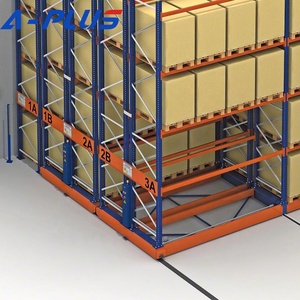
| Electrical Mobile Racking | Ultra-High (80%-85%) | 100% Sequential | Standard Reach Trucks, AGVs | 2,000 - 3,500 kg | Cold Storage Facilities, High-Value Raw Materials |
| Push-Back Cart Racking | High (65%-75%) | LIFO (Last-In-First-Out) | Standard Forklifts | 1,000 - 1,800 kg | Food & Beverage, Moderate SKU Velocity, Bulk Buffer |
| Mini-Load ASRS System | Maximum Vertical Cube | 100% Automated Robotic | Automated Stacker Cranes | 50 - 300 kg (Totes) | Electronics, Pharmaceutical Picking, Aerospace Spare Parts |
| Drive-In / Drive-Through | Very High (70%-80%) | LIFO / FIFO | Counterbalance, Narrow Reach | 1,000 - 2,000 kg | Seasonal Bulk Storage, High-Volume Homogeneous SKUs |
The global warehousing and intralogistics racking industry is traversing a pivotal inflection point driven by warehouse land scarcity, labor shortages, and aggressive net-zero carbon mandates. For global EPC contractors, supply chain directors, and system integrators, procuring industrial bulk storage systems now necessitates future-proofing for robotic automation and carbon lifecycle compliance.
Traditional static pallet storage is increasingly modified to support autonomous mobile robots (AMRs) and automated forklifts. Autonomous material handling demands higher structural tolerances: column verticality deviation must stay below 1/1000, floor track straightness must adhere to DIN 15185 standards, and bottom beam clearance zones must integrate laser-guided safety margins. Forward-thinking procurement teams specify OEM racking pre-machined with floor guidance channels, optical target mounting brackets, and wireless base anchors ready for automated transition.
Structural health monitoring (SHM) is transitioning from aerospace and civil bridges into industrial racking. Next-generation bulk storage facilities incorporate embedded strain gauges, piezoelectric impact sensors, and RFID load monitoring nodes along primary load beams. These sensors feed live deformation and impact telemetry to the facility's Warehouse Execution System (WES), proactively warning engineers of localized plastic deformation before catastrophic structural failure occurs.
With environmental, social, and governance (ESG) reporting becoming mandatory across Europe (CSRD regulations) and North America, structural steel procurement demands low-embodied-carbon verification. As a forward-thinking exporter, our manufacturing processes utilize scrap-recycled Electric Arc Furnace (EAF) steel alongside renewable solar-powered roll forming, delivering verifiable Environmental Product Declarations (EPD) that reduce the total Scope 3 carbon footprint per pallet position.
From single standard container orders to multi-acre automated turnkey logistics complexes, we supply global clients with certified structural integrity, customized stamping profiles, and mill-direct export efficiency.
18 high-precision continuous roll-forming lines capable of profiling steel thicknesses from 1.5mm to 3.5mm with precision-aligned beam slot pitches (50mm, 75mm, 76.2mm).
Automated 6-axis Panasonic and OTC robotic welding stations executing deep-penetration seam welds on all connector brackets, ensuring zero air voids and absolute fatigue resistance.
Full in-house tool & die workshop. We engineer proprietary hole patterns, specific gauge requirements, seismic anchor plates, and cold-storage anti-icing designs tailored to regional requirements.
Comprehensive in-house lab conducting tensile yield strength testing, impact resistance, spectrophotometer color matching, and ultrasonic weld non-destructive testing (NDT).
Clear, technically sound answers addressing engineering standards, import logistics, load testing, and custom manufacturing parameters.
Our heavy-duty upright frames and load beams are roll-formed predominantly from certified Q235B and Q355B (equivalent to European S235JR and S355JR / ASTM A36 and A572 Grade 50). Every manufacturing batch is accompanied by original Mill Test Certificates (MTC) conforming to EN 10204 3.1, verifying exact chemical composition, yield stress (ReH ≥ 355 MPa), tensile strength (Rm ≥ 490 MPa), and elongation percentages.
For seismic active regions (such as the US West Coast, New Zealand, Chile, Japan, or Southern Europe), our structural engineering division computes dynamic response spectrum analyses following IBC/ASCE 7 or Eurocode 8. We engineer oversized floor baseplates, reinforced anchor bolt patterns, horizontal back-to-back ties, and diagonal vertical bracing lattices to safely disperse lateral ground acceleration vectors.
All upright columns and horizontal beams are bundled using industrial timber dunnage blocks, high-tensile steel strapping, heavy-gauge poly-stretch film, and corrugated edge board protectors. Connector claws and smaller hardware parts are crated in solid fumigated wooden boxes (ISPM-15 compliant) with desiccant packs to prevent moisture condensation and corrosion during long ocean transit.
Yes. Our OEM/ODM tooling department regularly reproduces proprietary beam-to-frame slot configurations, pitch depths (such as teardrop, European 50mm, Dexion-compatible 76.2mm, or Speedlock configurations), custom column depths, and specialized baseplates to ensure seamless physical compatibility with existing warehouse racking retrofits.
Standard production lead times for standard FCL (Full Container Load) shipments range between 20 to 30 days following engineering shop drawing approval and deposit receipt. For complex automated ASRS projects or custom-tooled cold-storage systems requiring dedicated die sets, lead times typically run 35 to 45 days including pre-assembly trial erection and dimensional auditing.
Every customized project includes complete structural calculation documentation signed off by our licensed mechanical engineers, detailing dead loads, live loads, wind load tolerances (for rack-clad warehouses), safety factors (≥1.5), and floor load distribution charts. Comprehensive 3D CAD/BIM installation blueprints with part-numbered exploded views are supplied with each container.
Connect directly with our senior structural racking engineers. Submit your warehouse architectural layout (DWG/PDF), payload requirements, and lift-truck specifications for a comprehensive load calculation, 3D CAD design proposal, and direct factory price quotation.