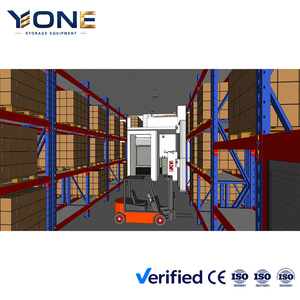
+45%
Cube Utilization Gain
EN 15512
Certified Structural Rigidity
Q235B / Q355
Structural Grade Steel Core
100%
Pallet Accessibility (FIFO)
Engineered Heavy-Duty Racking & Narrow Aisle Portfolios
Manufactured to rigorous tolerances under EN 15512 and FEM design regulations. Select from our certified standard lines or configure custom high-density aisle systems tailored to precise warehouse load profiles.
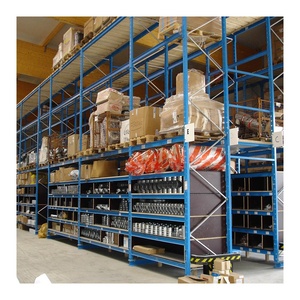
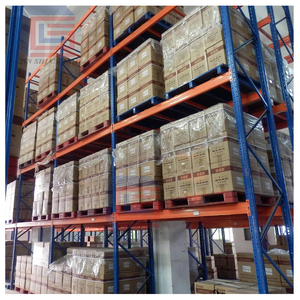
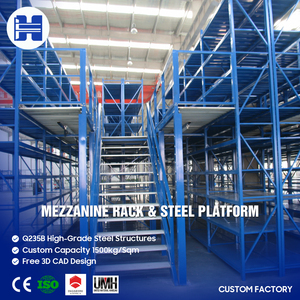
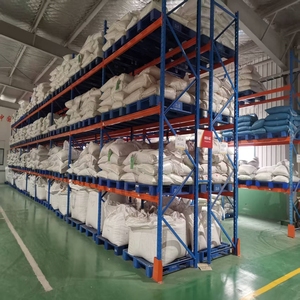
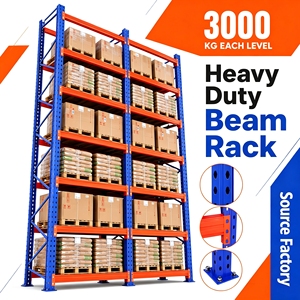
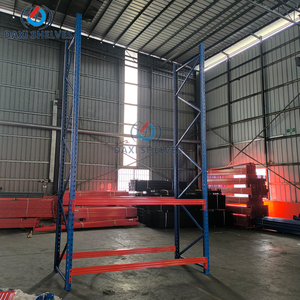
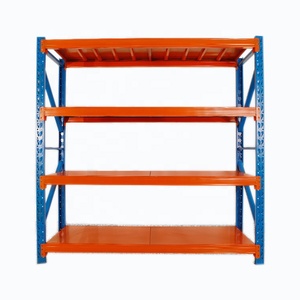
Why Industrial Engineers & Procurement Choose Our Factory
Combining full lifecycle engineering—from finite element analysis and CAD layout optimization to certified fabrication, seismic bracing, and lifecycle inspections.
EN 15512 Compliance
Every frame, connector, and beam assembly is verified against rigorous European EN 15512 and FEM 10.2.02 deflection safety thresholds.
P90 Structural Core
Precision-rolled cold-formed upright profiles providing superior torsional stability, enabling warehouse heights exceeding 18 meters.
Turnkey Retrofitting
Engineered site adaptations that re-profile beam heights, convert broad-aisle setups into VNA lanes, and integrate floor guide rails with zero downtime.
Traceable Steel Supply
Fabricated strictly using certified high-tensile Q235B and Q355 structural steel with complete batch metallurgy and impact test certifications.
Automation Compatible
Seamless physical tolerances designed for VNA man-up turret trucks, wire guidance, automated guided vehicles (AGVs), and 4-way shuttle runners.
Technical Analysis: Narrow Aisle Racking Architectural Mechanics
The shift from conventional selective pallet racking to Very Narrow Aisle (VNA) Heavy-Duty Systems represents the most cost-effective structural intervention for logistics facilities facing escalating industrial land valuations. While standard counterbalanced forklift layouts demand aisle clearances spanning between 3,500 mm and 4,200 mm, an optimized narrow aisle configuration contracts operating corridors down to 1,500 mm to 1,900 mm. By liberating up to 45% of redundant floor space and reallocating it directly into vertical pallet storage, warehouse operators achieve volumetric cube efficiencies unmatched by conventional platforms.
However, the physics governing narrow aisle structural engineering requires strict structural calculations. As beam heights extend to 12, 15, or even 18 meters, static and dynamic deflection ratios amplify dramatically. At DEXION-standard engineering thresholds, structural deflection is governed strictly below the Eurocode limit of 1/200th of the clear beam span (L/200), ensuring that turret trucks and Automated Guided Vehicles (AGVs) operate without the danger of load-sway interference during simultaneous high-bay transit and lifting sequences.
Structural Performance Matrix: Conventional vs. Narrow Aisle vs. Automated Systems
| Performance Metric | Conventional Selective Racking | Heavy-Duty Narrow Aisle (VNA) | 4-Way Shuttle High-Density |
|---|---|---|---|
| Operating Aisle Width | 3,500 mm – 4,000 mm | 1,550 mm – 1,850 mm | Self-Contained Dynamic Rails |
| Floor Area Utilization | ~35% to 40% Floor Coverage | ~60% to 65% Floor Coverage | Up to 85% Volumetric Density |
| Selectivity Rate | 100% Immediate Direct Access | 100% Immediate Direct Access | High-Density Channel (LIFO/FIFO) |
| Maximum Frame Height | Up to 10 – 12 Meters | Up to 18 Meters Engineered | Up to 24+ Meters Automated High-Bay |
| Floor Flatness Tolerance | ISO 1074 / DIN 18202 Table 3 | DIN 15185 / VDMA Superflat Class | Structural Foundation Grounded |
| Guidance Infrastructure | Manual Driver Steering Only | Mechanical Guide Rails / Wire Inductive | Software Controlled Optical / Laser WCS |
Furthermore, floor flatness specifications cannot be overlooked. In narrow aisle configurations utilizing specialized man-up or man-down VNA turret trucks, millimetric variations in concrete slab flatness produce extreme lateral tilt at high pick faces. Consequently, our engineering team enforces DIN 15185 and TR34 (Free Movement & Defined Movement) slab evaluations prior to finalizing frame baseplate engineering, anchoring depth, and column load dispersers.
Industrial Procurement Trends: The Next Decade of High-Bay Storage
Procurement directors and supply chain operations leaders are transitioning from viewing racking as passive steel structures to regarding them as dynamic, integrated material handling substrates. As global logistics networks adapt to near-shoring, labor shortages, and multi-channel fulfillment velocity, three major trends are dictating warehouse racking purchasing trajectories:
1. Convergence Toward Hybrid Automation-Ready Assets: Modern buyers are increasingly bypassing single-purpose static racks in favor of modular platforms designed for phased automation. System designs such as our P90 structural profile allow operators to initiate operations with standard narrow aisle wire-guided turret trucks today, while retaining the exact load capacity, tolerance profile, and horizontal clearances required to deploy fully automated 4-way pallet shuttles or autonomous mobile reach robots (AMRs) in subsequent fiscal phases.
2. Stringent Seismic and Dynamic Resilience Demands: With cross-border trade intensifying in seismically active regions across the Americas, Southern Europe, and the Pacific Rim, international procurement now mandates finite element non-linear analysis. Certified racks must demonstrate controlled ductility under earth movement while maintaining pallet retention integrity through bolted lockpins, heavy-gauge row spacers, and customized base assemblies.
3. Circularity, High-Strength Metallurgy, and Low-Carbon Profiles: Sustainability reporting is directly influencing steel specifications. Procuring hot-rolled, resource-heavy profiles is being supplanted by optimized cold-formed micro-alloy steels (such as high-yield Q355B and European equivalents). This achieves equal or superior moment capacities with 12% to 18% less deadweight, reducing embodied carbon, lowering international freight tonnages, and delivering lower lifecycle costs per pallet footprint.
Frequently Asked Questions by Industrial Buyers & Engineers
Essential considerations regarding clearances, machinery matching, safety compliance, and installation timelines.
Q1: How does floor slab quality impact narrow aisle racking stability?
In narrow aisle high-bay systems, truck wheels traverse the identical linear path repeatedly. Imperfections in floor flatness cause amplified truck sway at high lift elevations. Meeting DIN 15185 or TR34 Defined Movement (DM) standards is mandatory to avoid structural racking strikes and ensure mast safety clearances.
Q2: What are the mechanical differences between wire-guided and rail-guided VNA aisles?
Mechanical guidance utilizes low-profile steel guide rails anchored continuously along the bottom frames, physically steering the vehicle’s guide rollers. Wire guidance embeds an inductive frequency wire in the center of the concrete floor slab, tracking the truck via onboard sensors. Wire guidance maximizes bottom-tier access and simplifies floor housekeeping, while steel rails offer bulletproof physical protection.
Q3: Can existing selective pallet racks be converted to a narrow aisle layout?
Yes. A warehouse retrofit can consolidate broad aisles into narrow corridors. However, it requires reassessing column footings, installing heavy-duty end-of-aisle crash barriers, verifying upright verticality within FEM 10.2.02 tolerances, and potentially upgrading beam connector clips to withstand higher picking frequencies.
Q4: How often must high-density narrow aisle systems undergo formal safety inspection?
Under European Standard EN 15635, warehouse operators must conduct weekly visual inspections via an appointed Person Responsible for Racking Safety (PRRS) and schedule an exhaustive, certified structural survey by an independent expert at intervals not exceeding 12 months. Immediate assessments must follow any mast or vehicle collision.
Q5: What surface finish provides the highest longevity in cold stores and humid facilities?
For standard temperature-controlled warehouses, high-durability electrostatic thermosetting epoxy-polyester powder coating cured at 200°C delivers superior impact resistance. For deep-freeze environments (-25°C) or chemical storage, continuous hot-dip galvanizing to ISO 1461 provides lifetime rust protection against condensation and thermal cycling.
Q6: What data does your engineering department require to generate a complete layout?
We require warehouse architectural drawings (clear height under hook, column spacing, floor joint layouts), pallet dimensions with overhang tolerances, maximum pallet gross weights, lift truck specifications (mast collapsed height, lift reach, turning radius), and local seismic acceleration coefficients.
Ready to Engineer Your High-Density Narrow Aisle Facility?
Request comprehensive CAD engineering layouts, static load calculation dossiers, and factory-direct volume pricing from our technical application engineers.
Get Catalog