Heavy-Duty 5-Layer
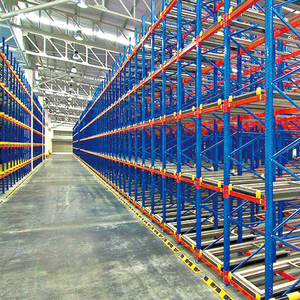
Discover our heavy-duty telescoping nesting cart push-back configurations designed to boost cube utilization by up to 75% without aisle-entry forklift interference.
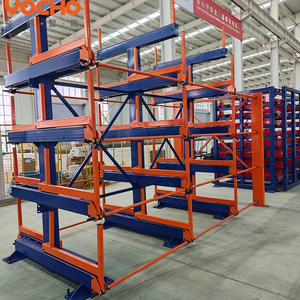
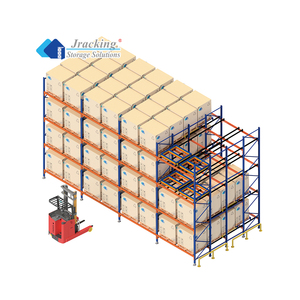
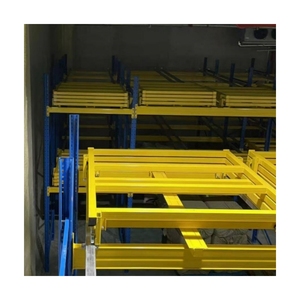
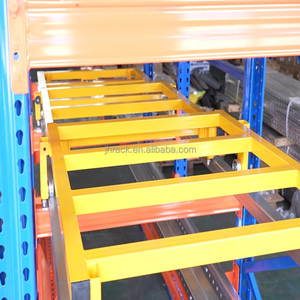
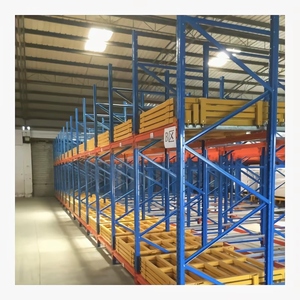
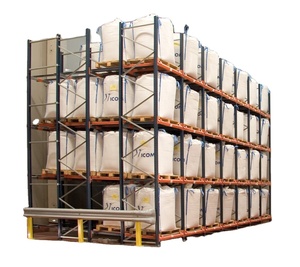
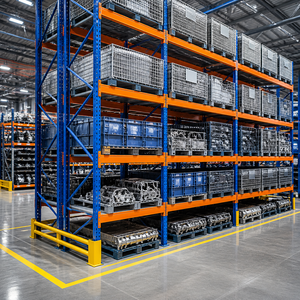
Unlike conventional drive-in racks that require mast trucks to enter tight vertical corridors, push back systems harness an inclined carrier-cart platform on heavy-duty flanged wheel assemblies to achieve seamless Last-In, First-Out (LIFO) inventory throughput.
Every push back racking run manufactured for our Bangkok and Southeast Asian clients features low-profile structural steel nesting carts fabricated from high-tensile Q235B and Q355B cold-rolled steel. The system operates on a engineered 2% to 3% gravitational incline. When loading, the reach truck gently pushes the already seated front pallet backward, revealing the next nested cart underneath.
Upon unloading, gravitational inertia slowly glides the rearward pallets toward the picking aisle at a strictly governed speed. This eliminates upright impact risks common in drive-in racking and cuts forklift transit cycle times by more than 40% across large-scale logistics operations.
| System Parameter | Engineering Standard / Specification |
|---|---|
| Design Standard | EN 15512:2020 / FEM 10.2.02 / SEMA Design Code |
| Pallet Depth Capacity | 2 to 6 Pallets Deep (Telescopic Nested Trolley System) |
| Load Capacity Per Position | 500 kg to 1,500 kg per pallet location (Customized up to 2,000 kg) |
| Incline Gradient | Graduated 2.0% – 3.2% slope (Calibrated to load friction coefficients) |
| Bearing & Wheel Architecture | Dual-shielded, heavy-load sealed bearings with anti-drift flanges |
| Finish Protection | Thermoset epoxy polyester powder coat (80–120 µm) or Hot-Dip Galvanized |
| MHE Compatibility | Standard Counterbalance, Reach Trucks, articulated VNA, and AGVs |
From land-constrained warehouse hubs along Bangna-Trad to high-throughput manufacturing plants in Samut Prakan and Chonburi, push-back storage solves regional storage volume bottlenecks.
Industrial land leasing rates along Bangna-Trad have surged dramatically. Push back systems enable 3PL providers handling high-velocity consumer goods (FMCG) to pack 2-to-5 deep pallets per lane without sacrificing SKU selectivity, keeping every vertical lane dedicated to distinct batch IDs.
Energy expenses dominate sub-zero refrigerated facilities. Push back racking condenses the refrigerated footprint by over 60%, drastically cutting the kilowatt-hour cooling overhead per pallet while utilizing low-temperature lubes and anti-corrosive galvanized steel to survive condensation.
Thailand’s booming Electric Vehicle (EV) assembly lines demand robust buffer storage for heavy battery modules and stamped sheet parts. High-capacity structural push-back channels provide high density buffering without subjecting expensive components to forklift fork impacts.
How structural engineering, automation integration, and real estate market pressures are transforming procurement decisions in Bangkok factories.
With prime logistics zones near Suvarnabhumi Airport commanding peak rental costs, logistics directors can no longer afford wide, non-productive operating aisles. Push back storage consolidates 4 to 5 selective rack aisles into a single operational roadway, freeing massive ground area for staging and value-add cross-docking.
Automated Guided Vehicles (AGVs) and vision-guided counterbalanced robotic reach trucks are rapidly being deployed across Bangkok manufacturing plants. Our push back racking carriages incorporate optical alignment notches and mechanical end-stops, enabling driverless handling units to load and retrieve pallets with millimeter precision.
Bangkok’s high relative humidity and tropical monsoon seasons cause rapid oxidation on sub-par steel coatings. Modern procurement requires heavy thermoset zinc-rich powder treatments and hot-dip galvanization conforming to ISO 12944 standards to guarantee decades of rust-free, low-friction trolley gliding.
Combining European structural compliance with direct factory customization, complete material traceability, and turn-key installation across Thailand.
From preliminary structural feasibility audits and dynamic 3D CAD simulation to automated roll-forming, installation supervision, and yearly safety certifications, we handle every milestone internally.
All upright profiles, dynamic trolley rails, and connector beams are engineered strictly to EN 15512 and FEM 10.2.02 codes. Structural steel heat certificates and full batch test logs accompany each shipment.
Bangkok's unique alluvial soil profile requires specialized base plate footings and anchor calculations. Our structural engineering team calculates local ground load vectors to ensure absolute seismic and floor stability.
Our nesting carts use hardened steel flanged wheels with sealed, self-lubricating ball bearings. This prevents debris build-up, prevents track binding, and ensures zero derailments under maximum payload.
Essential answers on dynamic push-back storage, installation lead times, pallet size compatibility, and safety protocols for Thai warehouse facilities.
Get CatalogReceive an engineering layout assessment, custom payload calculations, and direct-factory pricing tailored to your warehouse dimensions within 24 hours.
Get Catalog