Precision High-Density Pallet Racking & Industrial Systems
Direct factory fabrication conforming to European warehouse directives, seismic ratings, and custom industrial pallet footprints for Austrian 3PL, FMCG, and automotive distributors.
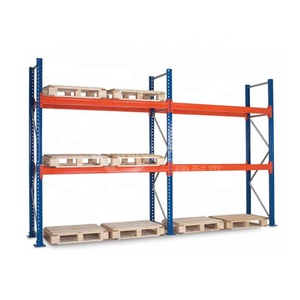
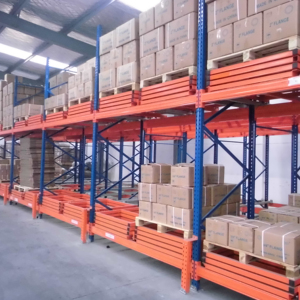
The Engineering Architecture of Double Deep Pallet Racking in Austrian Facilities
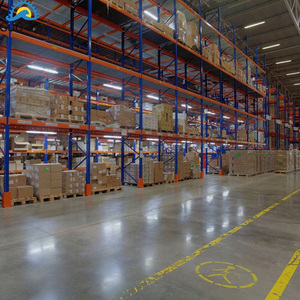
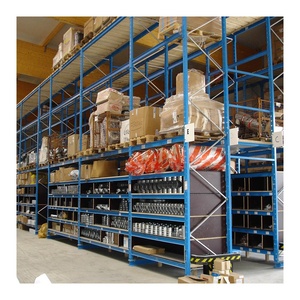
For operations directors across industrial estates in Lower Austria, Upper Austria, and Styria, warehouse expansion often meets geographic and municipal planning barriers. Double deep racking addresses this footprint pinch by staging pallet loads two positions deep in a back-to-back layout, effectively eliminating alternate operating aisles and reducing floor area requirements by up to 35% compared to conventional single-selective configurations.
Under European standard EN 15512:2020 (Racking Static Steel Design), upright columns and horizontal box beams are subject to complex torsional and bending stresses caused by the lever arm formed when placing an 800×1200 mm Euro-pallet (or 1000×1200 mm industrial pallet) into the deep rear tier. Our factory applies specialized cold-rolled profile geometry, high-elastic-limit steels, and bolted bracing trusses to ensure beam deflection never exceeds L/200 under maximal working loads.
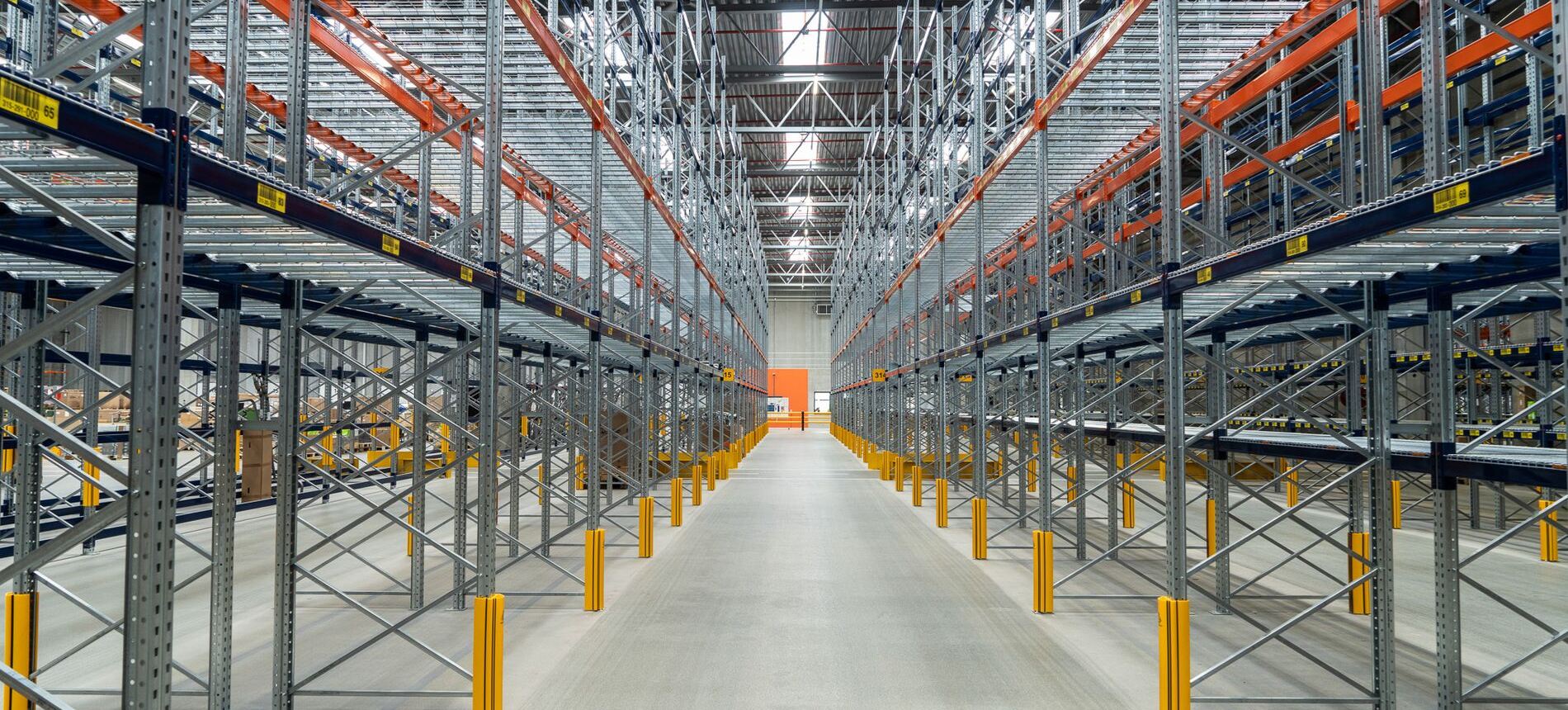
| Storage Topology | Floor Space Efficiency | Direct Selectivity | Forklift Compatibility | Typical Austrian Deployment |
|---|---|---|---|---|
| Double Deep Racking | 60% – 65% Cube Utilization | 50% Direct Access (FILO / FIFO batch) | Pantograph Reach / Telescopic Reach Truck | Cold Storage (Marchtrenk), FMCG, Buffer Hubs |
| Standard Selective (Single Deep) | 40% – 45% Cube Utilization | 100% Direct Immediate Access | Counterbalance, Standard Reach, VNA | High-SKU E-commerce, Spare Parts, General 3PL |
| Drive-In / Drive-Through | 70% – 75% Cube Utilization | Low (Last-In First-Out per lane) | Standard Counterbalance / Reach | Bulk Raw Materials, Seasonal Beverage Production |
| Mobile Racking (MOVO System) | 80% – 85% Cube Utilization | 100% Direct Access (Aisle on Demand) | Standard Reach, Guided Forklifts, AGV | High-Value Cold Stores (-28°C), Alpine Footprints |
Strategic Deployments Across Austrian Logistics Hubs
Austrian supply chains sit at the critical intersection of Western European transport corridors and Central-Eastern European (CEE) freight networks. Below is how our racking configurations serve key federal regions.
Metropolitan Distribution & CEE Cross-Docking
In industrial clusters like Wiener Neudorf, Schwechat, and Hagenbrunn, where land lease costs command steep premiums, double deep systems serve as high-throughput transit buffers. Staging fast-moving pallet batches two-deep allows contract logistics providers to double buffer capacity for goods moving onward into Slovakia, Hungary, and the Czech Republic.
Automotive Supplier & Heavy Engineering Buffers
Serving Tier-1 and Tier-2 automotive component suppliers connected to the Enns harbor intermodal hub and BMW Motoren Steyr. Double deep racks configured with custom heavy box beams (up to 4,500 kg per level) manage heavy steel coil cages, die castings, and standardized Gitterbox containers without floor slab distortion.
Just-in-Sequence (JIS) Sub-Assembly Buffering
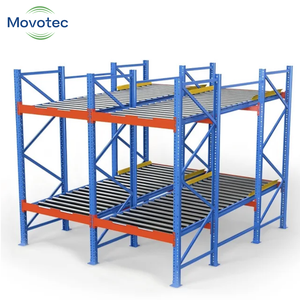
In the southern automotive hub around Graz, facilities require rapid, high-density batch replenishment. Double deep configurations are engineered alongside integrated gravity roller picking lanes on bottom levels, allowing bulk replenishment on upper double deep positions while ground pick-faces operate uninterrupted.
Topographic Footprint Constraints & Seismic Factors
In the narrow Inn Valley and Rhine Valley basins, greenfield building permits are severely restricted. Racking systems must exploit every cubic meter up to clear ceiling heights. Furthermore, structural dynamic layouts in these zones incorporate earthquake-resistant structural steel detailing in full accordance with ÖNORM EN 16681.
Emerging Intralogistics & Racking Trends in Austria
How ecological directives, land restrictions, and modern handling automation are transforming Austrian logistics spaces.
The 2.5-Acre Land Restriction Rule
Austrian municipal governments are strictly limiting new zoning for logistics brownfields to curb soil sealing (Bodenversiegelung). Consequently, operators must double storage capacity within existing building envelopes. Double deep racking allows conversion of standard 3.2-meter wide reach truck aisles into high-density storage blocks, unlocking vertical cube capacity without expanding facility perimeters.
ÖGNI & DGNB Green Logistics Standards
Sustainability certifications by the Austrian Sustainable Building Council (ÖGNI) demand energy efficiency in temperature-controlled spaces. In refrigerated and deep-freeze logistics (down to -28°C in Styrian fruit and dairy corridors), cubic volume directly translates to cooling power. Double deep and compact racking drastically reduce cooled airspace per stored pallet, delivering measurable kWh savings.
Semi-Automated AGV & Camera Guidance
With ongoing labor shortfalls in Upper and Lower Austria, warehouses are shifting from manual reach trucks to automated guided reach vehicles (AGVs) equipped with 3D optical cameras and laser rangefinders. Our double deep racks feature ultra-precise manufacturing tolerances (beam-to-column locking within ±0.5 mm) to guarantee fail-safe automated pallet positioning at 11-meter lift heights.
Why Global Logistics Operators & Austrian Integrators Trust Our Factory
As a specialized manufacturer of industrial storage systems, our facility combines automated continuous roll-forming lines, robotic multi-point welding, and electrostatic powder coating to engineer double deep and heavy-duty storage infrastructures that endure rigorous industrial lifecycles.
Certified European Steel (EN 10025)
We use solely high-strength structural grade steels (Q235B, Q355B equivalent to European S235JR and S355JR). Every coil batch undergoes tensile, yield, and charpy impact testing, complete with 3.1 Mill Test Certificates ensuring zero structural fatigue under cyclical tele-reach stress.
Structural FEA Calculations (EN 15512)
Our in-house engineering team calculates precise load tables, baseplate pressure distribution, and beam connector stiffness using advanced Finite Element Analysis (FEA). Static documentation is delivered ready for Austrian building control and commercial safety audits (AUVA compliant).
End-to-End Turnkey Execution
From custom CAD warehouse slotting analysis and clearance layout planning to containerized export shipping, customs clearance coordination, and on-site assembly supervision, we deliver dependable lifecycle support for system integrators and end-users alike.
Frequently Asked Questions by Austrian Plant Managers
Essential technical, operational, and regulatory clarifications regarding double deep pallet racking procurement in Austria.